Who we serve / Pool cleaning
Estimates and invoices for pool cleaners, for the repairs, clean-ups and chemicals.
A normal visit is easy to explain. The arguments start with the chemicals, the green pool and the pump that turns out to need more than a new seal. Here is how to get each one agreed before you do it.
By Abrar · Updated · 9 min read
Free plan available. No credit card for Free.
The short answer
Pool service money is lost in the extras: chemicals nobody can account for, a clean-up that the customer thought was included, and a repair priced before the fault was seen. Write down what a normal visit covers. List each chemical with its amount. Price repairs after you look, and get a yes first. InvoiceWren keeps each of those on one job, with the balance explained.
How pool service runs on paper
A pool job is part routine and part surprise. The routine needs a clear list of what is covered. The surprise needs a price and a yes before you start.
- 1
The first contact
An owner calls, or a neighbor sends them. Write down the address, the type of pool (chlorine, salt, plaster, vinyl, fiberglass), whether there is a spa, how you get in, and what they want: regular service, a one-time clean or a repair.
- 2
The first look
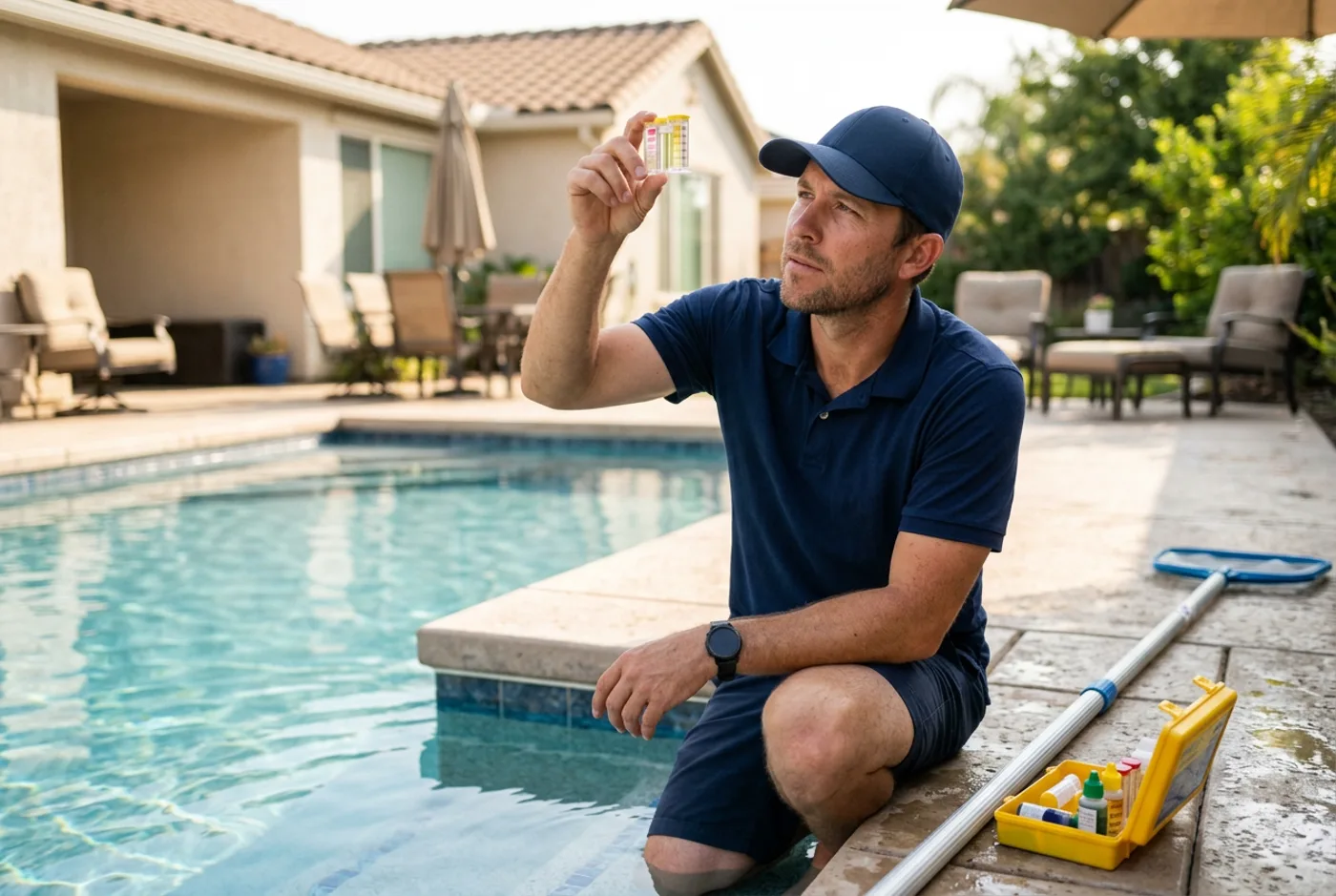
Test the water and check the pump, filter, heater and cleaner. Write down the readings, the color of the water, any equipment problem and a few photos. The CDC recommends testing chlorine and pH at least twice a day on a home pool [1]; that is advice for the owner, but it tells you what to read and write down.
- 3
What is covered
Write what a normal visit includes: skim, brush, vacuum, empty the baskets, test, balance. Texas describes pool maintenance as testing, acid washing, adding and balancing chemicals, cleaning and changing filters, and vacuuming [2]. Then write what counts as extra: a green pool, a deep filter clean, an acid wash, a repair.
- 4
The visit
Skim, brush, vacuum, test, add what the water needs. Write down the date, the readings, each chemical you added and anything you saw that is wrong.
- 5
The extra
A worn pump seal, a cracked skimmer lid, a heater that will not fire, an algae bloom that needs more than one treatment. The owner says yes before you do it and before you bill it.
- 6
The invoice
Chemicals and parts as their own lines, one-time work as its own lines, tax if your state charges it on this service [2][3], the due date and how to pay.
- 7
The payment
Check, card, Zelle or bank transfer. Write down the date, the amount and which invoice it paid.
Where pool service paperwork goes wrong
Each is a bill that gets questioned, a job done for free or a license question.
Chemicals billed with no record of what went in
The bill shows one "chemicals" number. The owner asks what it was for, and you cannot show it. They question the whole bill, or stop paying for anything extra.
What to do: Give each chemical its own line with the amount and the date: liquid chlorine, acid, stabilizer, salt. Note the reading that made you add it. In Texas the chemicals sit inside a taxed service, so a clear line also helps with tax [2].
A price that does not say what it covers
The owner expects a green pool to be cleared inside the usual price. You expect to charge a clean-up. You either work for free or lose the customer. A pool that drifts for weeks can need more than a normal visit: the CDC says chlorine kills germs less well as pH goes up, especially above 8.0 [1].
What to do: Write what a normal visit covers and what is extra: green-to-clean, deep filter clean, acid wash, drain and refill, equipment repair. Name the trigger, for example "if the water is not clear and free chlorine reads zero".
A repair priced before the fault is seen
"The pump is noisy" turns out to be a motor, a seal or the plumbing behind it. Your first number was a guess, and the owner holds you to it.
What to do: Price finding the fault first. Then send a second, written price once you know, and get a yes before you start. California's contractor board tells pool customers that changes should be clearly worded and signed by both sides [4].
Work that crosses into a licensed job
A customer asks you to replace a pump or fix a line. In some states that needs a contractor license. Florida does not require one for cleaning that does not affect the structure of the pool or its equipment, but equipment work and cleaning that needs partial disassembly are inside the licensed scope [5]. California's pool and spa maintenance class covers installing, replacing and repairing pool motors, pumps, filters and gas heaters [6].
What to do: Learn where your state draws the line before you quote the job. Quote only what you may do.
Chemicals handled carelessly
The CDC reports an estimated 13,508 emergency department visits from pool chemical injuries in the United States from 2015 to 2017, and says never to mix chlorine products with acid [7]. OSHA says employers with hazardous chemicals must have labels and safety data sheets for exposed workers [8].
What to do: Keep a short list of what you carry, with its safety data sheet. Check with OSHA or your state about what applies to you.
Tax that is wrong or missing
In Texas, pool maintenance is a taxable service on residential property, even when a self-employed person does it [2]. New York lists swimming pool maintenance among the repair and maintenance services to real property where you must register for sales tax [3]. Other states differ.
What to do: Put tax on its own line when your state charges it. Ask your state tax office before your first invoice.
What InvoiceWren does for a pool cleaner
Your phone at the pool is enough: the extras, the repairs and the chemicals get written down and agreed there.
An estimate for the green pool, the filter and the pump
Write the clean-up, the filter clean and the repair as their own lines. Your customer reads it on their phone and signs it there, before you start.
Chemicals as lines, with the amount
Add liquid chlorine, acid and stabilizer as separate lines with quantities. The customer sees what went in, so the bill is easy to check.
Saved items for what you add every week
Save the lines you type again and again: a skimmer basket, a bag of shock, a filter clean, a trip charge. Next time it takes a tap per line.
A photo beside the line
Add up to 3 photos to a line. The cracked skimmer lid or the green water sits beside its price.
Change orders when the pump is worse than it looked
Found a failed fitting? Send a change order. Your customer approves it on their phone before you start. A change that is waiting is never counted as approved.
A deposit, then a balance that adds up
Take a deposit for a bigger repair. The final invoice shows the estimate, each approved change, the deposit and each payment, line by line.
Reminders that stop when they pay
If an invoice is late, InvoiceWren emails your customer for you. You set the schedule, and it stops the moment you confirm the payment.
Estimates and approval · Change orders · Deposits, progress and final invoices · Getting paid and receipts
Need a document right now? Make a free estimate or a free invoice with no sign-up, then bring the job into InvoiceWren when you are ready.
Rules to check, by state
Pool work is licensed and taxed state by state. These are examples from official pages we read on Nov 13 2026. They are not every rule. Check yours.
- Texas: pool maintenance is a taxable real property service on residential and nonresidential property. It includes testing, acid washing, adding and balancing chemicals, cleaning and changing filters, and vacuuming. A self-employed person who cleans a residential pool still charges the tax [2]. The Comptroller page is an older publication, so confirm it with the Comptroller.
- New York: swimming pool maintenance is on the Tax Department's list of repair and maintenance services to real property for which you must register for sales tax [3].
- Florida: a license is not required to clean a pool or spa in a way that does not affect the structural integrity of the pool or its associated equipment. Equipment work, and cleaning that needs at least a partial disassembly (not counting filter changes), is in the licensed scope [5].
- California: the state board's pool and spa maintenance class is for a contractor who installs, replaces or repairs pool motors, pumps, filters and gas heaters [6]. Ask the board whether your work needs it.
- California: for pool construction, the board's guide says a down payment cannot be more than 10 percent of the price or $1,000, whichever is less, and changes should be in a written change order signed by both sides [4]. That guide is about building a pool, not about service.
- Federal: if you sell at the customer's home, the Federal Trade Commission's cooling-off rule can let the buyer cancel until midnight of the third business day, and requires a completed receipt or copy of the contract [9]. The rule has exceptions. Ask the FTC or a lawyer whether your sale is covered.
- Health and safety: the CDC recommends a pH of 7.0 to 7.8 and at least 1 ppm of chlorine in a home pool, and testing at least twice a day [1]. That is advice for the owner, not a rule for a service visit.
This is general information, not legal or tax advice.
Checklist
Questions
Do I need a license to clean pools?
It depends on the state, and often on whether the work touches equipment or structure. Florida does not require a license for cleaning that does not affect the structure of the pool or its equipment, but equipment work is licensed [5]. In California the pool and spa maintenance class covers repairing pumps, motors, filters and heaters [6]. Check your state board.
Do I charge sales tax on pool service?
In Texas and New York, yes: both treat pool maintenance as a taxed service [2][3]. Other states differ. Ask your state tax office before your first invoice.
Do I charge tax on the chemicals I add?
Texas treats chemicals as part of the taxed service, and says a service company pays tax on the chemicals it buys [2]. Ask your tax office how your state treats them on an invoice.
How do I bill chemicals without a fight?
Give each one its own line with the amount and the date, and note the reading that made you add it. The owner can check it against what they saw.
What if the owner says a green pool should be inside the usual price?
Write the answer before it happens. On the estimate, say what a normal visit covers and name the clean-up as extra. Then send a separate estimate for the clean-up and get a yes.
What do I do when I find a bigger problem than I quoted?
Stop, show the owner, price it as its own line and get a yes before you go on. In InvoiceWren you send a change order, and the owner approves it on their phone.
Can I ask for a deposit?
For a repair, many pool owners do. The rule depends on the state. California's board guide for pool construction caps a down payment at 10 percent or $1,000, whichever is less [4]. Look up your state's rule for repair work.
Do I have to give a three-day cancellation notice?
If you sell at the customer's home, the Federal Trade Commission's cooling-off rule can apply, and it gives the buyer until midnight of the third business day to cancel [9]. The rule has exceptions, so ask the FTC or a lawyer about yours.
Send your next estimate from the job.
Free plan available. No credit card for Free.
Sources
- CDC: Home Pool and Hot Tub Water Treatment and Testing. Checked .
- Texas Comptroller: Cleaning and Janitorial Services (publication 94-111). Checked .
- New York State Tax Department: Do I need to register for sales tax?. Checked .
- California Contractors State License Board: A Consumer Guide to Swimming Pool Construction. Checked .
- Florida Statutes 2026, section 489.105: Definitions. Checked .
- California Contractors State License Board: D-35 Pool and Spa Maintenance Contractor. Checked .
- CDC MMWR: Pool Chemical Injuries in Public and Residential Settings, United States 2008 to 2017 and New York 2018. Checked .
- OSHA: Hazard Communication overview. Checked .
- Code of Federal Regulations, 16 CFR 429.1: Cooling-Off Rule, unfair or deceptive acts or practices. Checked .
Prices and features change. We check these pages before each update. If something here is out of date, tell us at hello@invoicewren.com and we will fix it.