Who we serve / Roofing
Estimates and invoices for roofers, including the jobs that an insurer pays for.
Roofing has a lot of storm work and a deductible rule that carries real fines. Here is how to write each part so that you can say exactly what was agreed.
By Abrar · Updated · 9 min read
Free plan available. No credit card for Free.
The short answer
A roofing estimate should list the tear-off, the materials, the flashing, the permit and what is not included, and say what a rotten board costs if one is found. Several states forbid offering to waive or rebate an insurance deductible, so never put that on paper. Keep the deposit within your state's limit. InvoiceWren holds the estimate, the changes and the payments on one job.
How a roofing job runs on paper
Many roofers send far more estimates than they win. Each step below is written so that the estimate that wins is also the one that is paid.
- 1
The call
A homeowner has a leak, a storm or an old roof. Write down the address, what they see and whether an insurance claim is open. If it is, the insurer decides what it pays. You write the estimate for the work.
- 2
The inspection
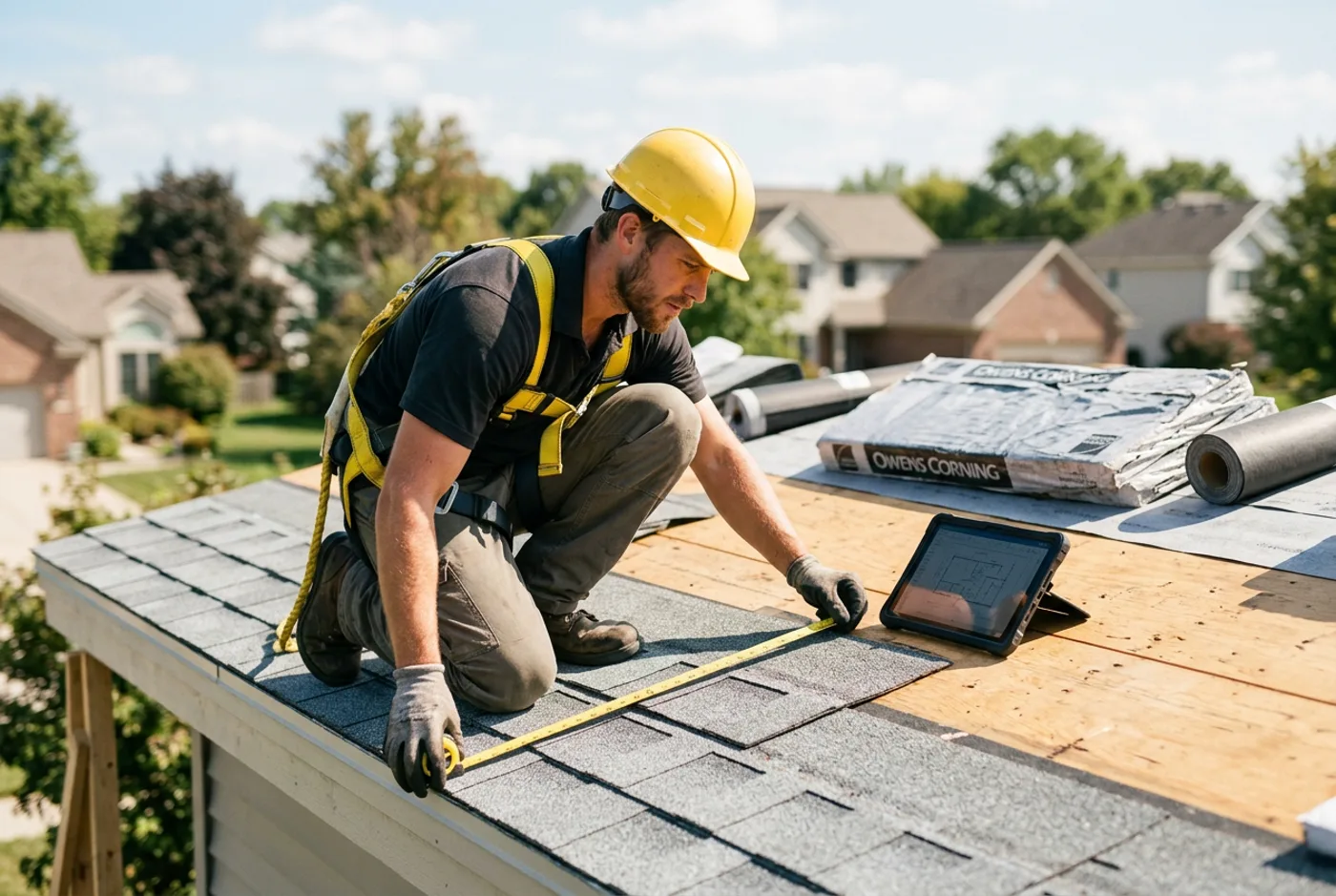
Go on the roof, or use photos from the ground and from a drone. Write down the layers, the pitch, the condition of the flashing and what you can see of the decking. Take photos. OSHA requires protection for workers 6 feet or more above lower levels in residential construction [1].
- 3
The estimate
List the tear-off and disposal, the shingles and underlayment, the flashing, the vents, the ridge cap, the permit and what is not included. Say what a rotten board costs if one is found.
- 4
The contract and the deposit
A written contract, signed by both sides. In New York, a home improvement contract must be in writing and signed by all the parties, and amendments must be in writing [2]. In California, a down payment cannot exceed 10 percent of the project price or $1,000, whichever is less [3].
- 5
The tear-off and the install
Do the work. Take photos of the decking when the old roof is off, before the new one goes on.
- 6
The rotten decking
Boards that are soft or wet cannot be seen from above. Write each one as its own change, with the price per sheet, a photo and a yes before you replace it. There is no official rule for this, but New York's law says amendments to a home improvement contract must be in writing [2].
- 7
The invoice
The estimate, plus approved changes, less the deposit. Show the permit fee as its own line.
- 8
The final payment and the receipt
Record the date, the amount and how you were paid, and give a receipt with the warranty.
Where roofing paperwork goes wrong
The first carries fines of up to $10,000 per violation in Florida.
Offering to cover the deductible
Florida bars offering a homeowner a waiver of any insurance deductible in exchange for a roof inspection or a claim, requires advertising to say the consumer is responsible for the deductible, and allows fines of up to $10,000 per violation [4]. Texas says it is illegal for a contractor to offer to waive, rebate or absorb a property insurance deductible [5]. New York says a roofing contractor shall not advertise or promise to pay or rebate any portion of an insurance deductible, and shall not do the reporting, adjusting or negotiating of the claim for the owner [6].
What to do: Never put "we cover your deductible" in an estimate, an ad or a text. Quote the full price, and let the owner deal with the insurer.
A deposit that is too big, or never used
In California the down payment cannot be more than 10 percent of the price or $1,000, whichever is less [3]. In Florida, taking more than 10 percent of the contract price as an initial payment on residential work brings duties to apply for permits within 30 days and start work within 90 days after the permits [7].
What to do: Ask for a deposit that fits your state, and for materials you must order first. Then start when you said you would.
The storm chaser problem
The New York Department of State warns that storm chasing contractors may promise a quick fix and low cost, and pressure owners to pay up front [8]. California's contractor board warns about a solicitor who offers roofing at a reduced price and does minimal work [3]. Owners are wary of every roofer who knocks.
What to do: Show who you are: your name, address, license and insurance on every estimate. Do not ask for the full price up front.
Rotten decking, and no price for it
The tear-off shows soft boards that nobody could see. You either replace them for free or surprise the owner.
What to do: Write the price per sheet on the estimate. When one is found, photograph it, send it as a change and get a yes first.
A cancellation after an insurance denial
New York lets the owner cancel before midnight on the third business day after written notice from the insurer that the claim or contract is not covered [6]. Florida lets the owner cancel without penalty within 10 days if the contract was signed within 180 days of a state of emergency in the declared area [4].
What to do: Learn the cancel rules in your state, and do not order special materials until the window has passed.
Estimates that outnumber the jobs
Roofers often send many estimates for each one they win. Each takes time to write, and a week later nobody remembers what it said.
What to do: Write each estimate with the same lines, and keep every one on its own job, so you can reopen and update the one that wins.
What InvoiceWren does for a roofer
You can send the estimate from the driveway, get a signature on the same phone, and keep the changes and payments together.
An estimate from the driveway
Add the tear-off, the shingles, the flashing, the vents and the permit as lines. Your customer reads it on their phone and signs it there.
Photos of the roof and the decking
Add up to 3 photos to a line. The damaged flashing and the soft board sit beside the line that prices them.
Saved items for what you quote every day
Save "tear-off, per square", "architectural shingles, per square", "replace decking, per sheet" and "permit fee, passed through". The next estimate takes a tap per line.
Change orders for the rotten board
Found decking that must be replaced? Send a change order with a photo. The customer approves it on their phone, and it is not counted as approved until they do.
A deposit, then a balance that adds up
Send a deposit invoice from the approved estimate. The final invoice shows the estimate, each approved change and each payment, line by line.
Paid by Zelle, bank transfer or your own link
Your customer pays you directly and we take no fee. They tap "I've paid", you check your account and confirm, and the receipt goes out.
Reminders that stop when they pay
If an invoice is late, InvoiceWren emails your customer for you. You set the schedule, and it stops once you confirm the payment.
Estimates and approval · Change orders · Deposits, progress and final invoices · Getting paid and receipts
Need a document right now? Make a free estimate or a free invoice with no sign-up, then bring the job into InvoiceWren when you are ready.
Rules to check, by state
Roofing sits between contractor law and insurance law, and the deductible rules differ by state. These are examples from official pages we read on Nov 13 2026. They are not every rule. Check yours.
- Florida: section 489.147 bars offering a waiver of any insurance deductible in exchange for a roof inspection or a claim, requires advertising to say the consumer is responsible for the deductible, requires a notice in the contract or the owner may void it within 10 days, and lets the owner cancel without penalty within 10 days if the contract was signed within 180 days of a state of emergency in the declared area. A contractor may receive a fine of up to $10,000 for each violation [4].
- Florida: section 489.126 says that if a contractor receives more than 10 percent of the contract price as an initial payment on residential work, the contractor must apply for permits within 30 days and start work within 90 days after the permits are issued, with exceptions [7].
- Texas: the Department of Insurance says it is illegal in Texas for a contractor to offer to waive, rebate or absorb a property insurance deductible [5].
- New York: General Business Law 771-b says a roofing contractor shall not advertise or promise to pay or rebate any portion of an insurance deductible, and shall not do the reporting, adjusting or negotiating of the claim for the owner. The owner may cancel before midnight on the third business day after written notice from the insurer that the claim or contract is not covered [6]. Section 771 requires a home improvement contract to be in writing and signed by all the parties, with amendments in writing [2].
- New York: the Department of State warns of storm chasing contractors who pressure owners to pay up front [8].
- California: the contractor board says a down payment cannot exceed 10 percent of the project price or $1,000, whichever is less, and warns about solicitors who offer roofing at a reduced price [3].
- Federal: OSHA requires protection for each employee in residential construction who is 6 feet or more above lower levels [1].
- We did not read an official page on roofing licensing in any state, or on sales tax for roofing, so ask your state.
This is general information, not legal or tax advice.
Checklist
Questions
Can I offer to cover the homeowner's deductible?
No, in several states. Texas says it is illegal for a contractor to offer to waive, rebate or absorb a property insurance deductible [5]. New York and Florida have similar rules [6][4]. Never put it in an estimate, an ad or a text.
Can I deal with the insurer for the homeowner?
In New York, a roofing contractor shall not do the reporting, adjusting or negotiating of the claim for the owner [6]. The owner deals with the insurer, and you write the estimate for the work.
How big a deposit can I ask for?
It depends on the state. California caps a down payment at 10 percent of the price or $1,000, whichever is less [3]. In Florida, more than 10 percent as an initial payment on residential work brings duties to get permits and start work on time [7].
What if the decking is rotten?
Write the price per sheet on the estimate. When you find some, photograph it and send it as a change. In InvoiceWren you send a change order, and the owner approves it on their phone.
Do I need a written contract?
In New York, a home improvement contract must be in writing, signed by all the parties, and amendments must be in writing [2]. A signed estimate in InvoiceWren is your written record of what was agreed.
Can the homeowner cancel?
It depends on the state. New York allows it before midnight on the third business day after written notice from the insurer that the claim or contract is not covered [6]. Florida allows it within 10 days for a contract signed within 180 days of a state of emergency [4].
Why do homeowners distrust roofers who knock?
The New York Department of State warns about storm chasing contractors who promise a quick fix and low cost and pressure owners to pay up front [8]. Show your name, license and insurance on every estimate.
What safety rule applies to my crew?
OSHA requires protection for each employee in residential construction who is 6 feet or more above lower levels [1].
Send your next estimate from the job.
Free plan available. No credit card for Free.
Sources
- OSHA: 29 CFR 1926.501, Duty to have fall protection. Checked .
- New York General Business Law, section 771. Checked .
- California Contractors State License Board: What You Should Know Before You Hire a Contractor. Checked .
- Florida Statutes 2026, section 489.147: Insurance deductible and roof inspections. Checked .
- Texas Department of Insurance: Roofing and insurance, know the law. Checked .
- New York General Business Law, section 771-b (roofing contractors). Checked .
- Florida Statutes 2026, section 489.126: Moneys received by contractors. Checked .
- New York Department of State: storm chasing contractor alert (Jul 31 2026). Checked .
Prices and features change. We check these pages before each update. If something here is out of date, tell us at hello@invoicewren.com and we will fix it.